
Watch 90-second demo
Specify how many times each course is taught during the week, and with just one click, the automated scheduler will expertly distribute those classes into available time slots in your schedule. Completely conflict free!
View all features →The student database is the centerpiece of our student information system. It is fully integrated with all other features within Quickschools, and offers a centralized view for school administrators, and teachers, to quickly find the information they need. Through powerful access right controls, you determine what information is available and what is shared with others. water supply and sanitary engineering rangwalapdf
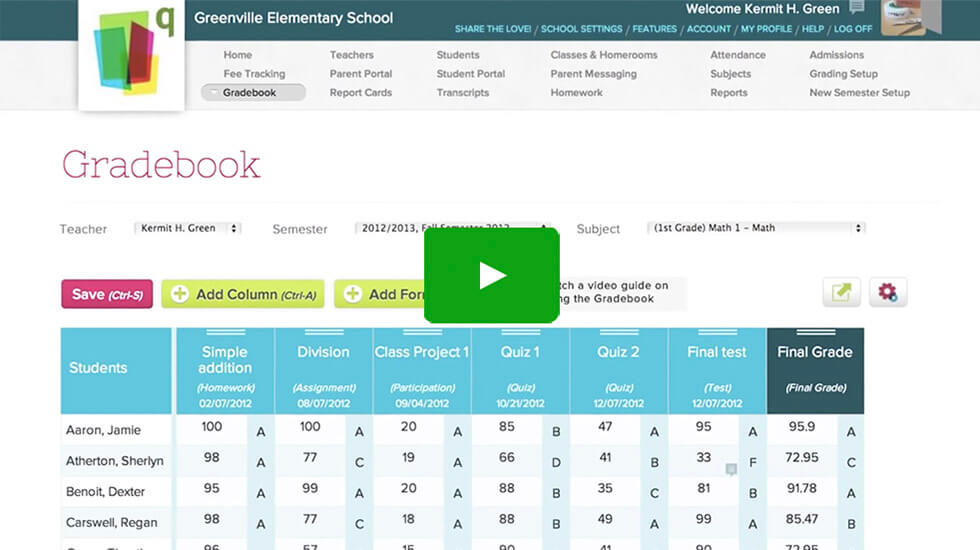
View QuickSchools features →Easily customize and assign weights to the assignments, quizzes, tests or any other exercises you wish to track in your gradebook. You can have multiple grading scales and use custom formulas to calculate a final grade for your class. Progress Reports and Report Cards are then just a click away. Core Structure of Rangwala's Textbook | | Key
View More QuickSchools features →We take online transcripts to another level here at Quickschools. Courses and grades are automatically populated to save you time. In addition, the templates are highly customizable and support a ton of options - you can even have your own custom built template for your school. Just ask! – Addresses wider ecosystems
Read more about our features →– Addresses wider ecosystems, including noise management, air pollution control, and municipal planning. Part I: Water Supply Engineering
Finding an authorized online can be challenging due to copyright restrictions. However, understanding the structured core layout of the text is essential for mastering public health engineering. Core Structure of Rangwala's Textbook
| | Key Formula / Value | Standard / IS Code | | :--- | :--- | :--- | | Per Capita Water Demand | 135–200 LPCD (for urban India) | IS 1172 | | Fire Demand (Kuichling) | ( Q = 3182 \sqrtP ) (P in thousands) | – | | Population Forecast | Arithmetic, Geometric, Incremental Increase | – | | Velocity in Pipes (min) | 0.6 m/s (to prevent siltation) | – | | Detention Time (Sedimentation Tank) | 2–4 hours | – | | Overflow Rate (Settling) | 30–40 m³/day/m² | – | | Filter Type (Slow Sand) | Rate: 100–200 L/hr/m² | – | | Filter Type (Rapid Sand) | Rate: 3000–6000 L/hr/m² | – | | Chlorine Dose (Normal) | 0.5–1.0 mg/L | – | | Sewage Flow | 70–80% of water supplied | – | | Min. Velocity in Sewer | 0.6 m/s (self-cleansing) | – | | BOD of typical sewage | 200–300 mg/L | – | | Sludge Digestion Time | 30–40 days | – |
His ability to break down complex engineering concepts into clear, understandable language has made his books a favorite among both students and faculty. The Rangwala brand is a hallmark of quality and reliability in technical education.
– Addresses wider ecosystems, including noise management, air pollution control, and municipal planning. Part I: Water Supply Engineering
Finding an authorized online can be challenging due to copyright restrictions. However, understanding the structured core layout of the text is essential for mastering public health engineering. Core Structure of Rangwala's Textbook
| | Key Formula / Value | Standard / IS Code | | :--- | :--- | :--- | | Per Capita Water Demand | 135–200 LPCD (for urban India) | IS 1172 | | Fire Demand (Kuichling) | ( Q = 3182 \sqrtP ) (P in thousands) | – | | Population Forecast | Arithmetic, Geometric, Incremental Increase | – | | Velocity in Pipes (min) | 0.6 m/s (to prevent siltation) | – | | Detention Time (Sedimentation Tank) | 2–4 hours | – | | Overflow Rate (Settling) | 30–40 m³/day/m² | – | | Filter Type (Slow Sand) | Rate: 100–200 L/hr/m² | – | | Filter Type (Rapid Sand) | Rate: 3000–6000 L/hr/m² | – | | Chlorine Dose (Normal) | 0.5–1.0 mg/L | – | | Sewage Flow | 70–80% of water supplied | – | | Min. Velocity in Sewer | 0.6 m/s (self-cleansing) | – | | BOD of typical sewage | 200–300 mg/L | – | | Sludge Digestion Time | 30–40 days | – |
His ability to break down complex engineering concepts into clear, understandable language has made his books a favorite among both students and faculty. The Rangwala brand is a hallmark of quality and reliability in technical education.