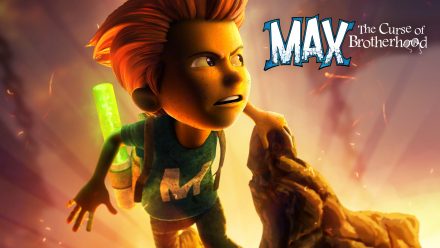
Combining traditional platforming with stunningly beautiful puzzle play, Max: The Curse of Brotherhood will take you on a cinematic fairy-tale adventure.
When Max wishes for his annoying little brother to be whisked away he gets more than he bargained for… Armed with only his trusty Magic Marker, Max must journey to a hostile and unforgiving world to rescue his kidnapped kid brother, Felix.
Draw your way through lantern-lit bogs, ancient temples and lush-green-forests, as you take on Mustacho’s henchmen. Use the marker to overwhelm your enemies, define new pathways and protect you on your quest.
Do not waiver. Unleash the power of the Marker, find your way through a frightening and fantastical world and take down the evil Lord Mustacho.
Release date: 8 June 2017
If you need any additional assets that are not listed, please request them via our contact form.
Denuvo's solution involves embedding a proprietary software component into the game, which communicates with a remote server to verify the game's legitimacy. This process involves a series of complex checks and validations, making it challenging for pirates to bypass or reverse-engineer.
Denuvo was founded in 2013 as a spin-off from Sony Digital Audio Disc Corporation. Unlike traditional DRM that prevents copying, Denuvo acts as a wrapper that prevents "tampering" with the primary DRM. Its goal is not to be uncrackable, but to protect the initial 30–90 day sales window 2. Technical Architecture denuvo source code
However, hackers and reverse engineers often obtain or—more commonly—the encrypted virtual machine bytecode during the debugging process. Unlike traditional DRM that prevents copying, Denuvo acts
designed to protect a game's existing DRM from being bypassed. ScienceDirect.com designed to protect a game's existing DRM from
The new generation of cracks, pioneered by hackers like and groups like MKDEV and DenuvOwO , weaponized this level. They created a custom hypervisor that loads before the operating system and the game. This hypervisor sits invisibly between the game and the hardware. When Denuvo asks the CPU for a “real” hardware ID or a “real” timestamp, the hypervisor intercepts the call and simply lies to it, feeding it the expected, legitimate data. As a result, Denuvo thinks it's running on a properly licensed machine when it actually is not.
A true source code leak means the underlying, human-readable programming language used to build Denuvo is exposed to the public. This differs significantly from reverse-engineering a compiled game file. How Leaks Typically Happen
Denuvo's solution involves embedding a proprietary software component into the game, which communicates with a remote server to verify the game's legitimacy. This process involves a series of complex checks and validations, making it challenging for pirates to bypass or reverse-engineer.
Denuvo was founded in 2013 as a spin-off from Sony Digital Audio Disc Corporation. Unlike traditional DRM that prevents copying, Denuvo acts as a wrapper that prevents "tampering" with the primary DRM. Its goal is not to be uncrackable, but to protect the initial 30–90 day sales window 2. Technical Architecture
However, hackers and reverse engineers often obtain or—more commonly—the encrypted virtual machine bytecode during the debugging process.
designed to protect a game's existing DRM from being bypassed. ScienceDirect.com
The new generation of cracks, pioneered by hackers like and groups like MKDEV and DenuvOwO , weaponized this level. They created a custom hypervisor that loads before the operating system and the game. This hypervisor sits invisibly between the game and the hardware. When Denuvo asks the CPU for a “real” hardware ID or a “real” timestamp, the hypervisor intercepts the call and simply lies to it, feeding it the expected, legitimate data. As a result, Denuvo thinks it's running on a properly licensed machine when it actually is not.
A true source code leak means the underlying, human-readable programming language used to build Denuvo is exposed to the public. This differs significantly from reverse-engineering a compiled game file. How Leaks Typically Happen

Publisher: Wired Productions
Developer: Flashbulb Games
Genre: Adventure, Platformer, Puzzle,
Formats: Nintendo Switch, PlayStation 4,
Release Date: PlayStation 4 - 8th November, 2017 / Nintendo Switch - 21st December, 2017

VO: English | Subtitles: English, French, German, Spanish - Spain, Spanish - LA, Portuguese - Brazil. © 2017 Flashbulb ApS. Developed and Published by Flashbulb ApS. Co-published by Wired Productions.
 © © 2026 Logan Beacon — All rights reserved.
Wired are proud to support the mental health charity for gamers – Safe In Our World